Top Rated Bitcoin Casino Sites of 2015
|
|
|
|
|
|
|
|---|---|---|---|---|---|

|
|
|
|
||

|
|
|
|
||

|
|
|
|
Bitcoin Casino Overview and Tips
Bitcoin casinos have been taking over the Internet as the ultimate medium for online gambling. Bitcoin offers up a secure, safe and fast method for sending funds from players to casinos and vice versa, making it the perfect way to get involved with online casinos – without having to wait weeks or months to see a deposit or withdrawal finish, or getting caught up due to payment processors refusing to process a payment.
There are online Bitcoin casinos that cover everything the physical (and online fiat) ones do, including slots, table games, sports betting, and anything in between. Essentially, the gaming is the same between all of them; what’s different is how the financing is handled, and the amount of personal information that must be shared with various sites. This has opened the doors for players to join a new Bitcoin gambling site, make a deposit, play through some of their money and withdraw their earnings, all in a matter of minutes, and from the security of their own homes or while mobile. It really couldn’t be more safe or easy.
Betting With Bitcoins
Betting with bitcoins is exactly the same as with cash, with a big benefit being that there are almost nonexistent fees with Bitcoin, making it entirely possible to play for micro-stakes or high stakes. Bitcoin poker sites, for example, often have cash tables with blinds as low as a fraction of a cent, and most slots and sports betting sites will allow for wagers of a cent or less. At the same time, they often allow bets of tens of thousands of dollars, allowing for locking down on the perfect wagers for any risk tolerance. And with Bitcoin often comes provably-fair gaming, a system that is unheard of in the physical casinos (as well as online cash ones).
Some sites will offer their wagers in a fiat-based amount, converting the bitcoins to fiat at the time a deposit is made or when a wager is made. Others will deal with everything solely in the cryptocurrency, for a much more fluid experience. In either of these cases, it’s imperative to watch the way funds are denoted, as there are also differences between some casinos doing wagers in satoshis (1/100,000,000 of a bitcoin), mBTC (1/1,000 of a Bitcoin), or in bitcoins themselves. Watching out for these differences will help ensure that the wagers are exactly what are expected, and additional risk isn’t being accidentally taken on. Do note that for the most part, Bitcoin casinos will denote their balances in mBTC, with some moving to a format of bits (1/1,000,000 of a bitcoin), which has been taking over a bit more as of lately.

Anonymity with Bitcoin
A great part of Bitcoin is that it’s anonymous. The vast majority of Bitcoin casinos don’t require any personal information, and some don’t even require any sort of accounts to be set up (though this is often recommended, just because it helps alleviate any potential issues with cookie-based logins). No personal data is tied to transactions or Bitcoin addresses, keeping everything private. And unlike cash-based casinos, no address, phone number, and verifying documents are needed at most, removing the annoyance of having to keep submitting identifying documents.
It is worth noting, however, that addresses can be indirectly tracked. For example, sharing an address publicly can taint it, especially if it’s being used, solely because that address is now linked to an identity. It’s always a good idea to use a separate address for each transaction, and to keep them.
Provably-Fair Gaming
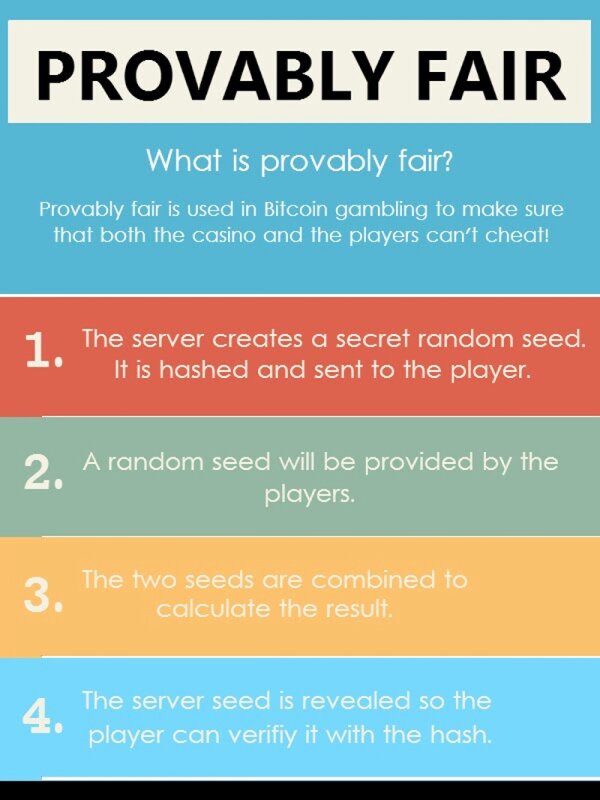
Most Bitcoin casinos offer up provably-fair methods of determining outcomes of rolls. Rather than having to trust the casino to be honest about how they came up with a number (as they could be cheating players) or some other third party that claims to be evaluating their RNG systems, this allows the players themselves to evaluate each outcome and ensure it was truly random. On top of this, rolls generally rely on a client seed, which players often have the ability to change, further ensuring that any rolls really are random (as the server would never know this seed ahead of time, and therefore could not alter anything to force specific results). This has led to a lot of transparency with Bitcoin casinos, increasing trust and accountability with them and further removing the need of players to be on edge about whether or not they are being cheated out of their hard-earned money. And for those less technically-savvy players, most casinos offer the source code for a script that will instantly verify any of the rolls on their site.
Obtaining Bitcoins
Getting bitcoins is easy. There are exchanges that allow users to easily transfer money to an account and then convert it to Bitcoin (or convert Bitcoin back into cash, to transfer bank to a bank account). The two major ones are Circle and Coinbase, both of which are licensed, granting the peace of mind of knowing that they aren’t just going to disappear due to being run illegally. On top of this, both of these come with low fees, and they have built-in Bitcoin wallets that make keeping up with bitcoins that much easier. Cash can be turned into Bitcoin, transferred to a casino to play through, withdrawn back to the wallet, and then withdrawn as cash.
The price of bitcoins fluctuates over time, as they are based on the principles of supply and demand. As more bitcoins are bought, the prices/values go up, and as more are sold, they go down. As such, the price can drop or rise right after making a purchase, though they have been somewhat stable as of lately. That said, this is important to be aware of, especially when dealing with casinos that price wagers in USD or other currencies, as those will also change as the price of bitcoins fluctuates.
Storing and Using Bitcoins
While reputable exchanges like Circle and Coinbase are often trusted as Bitcoin wallets, most users recommend storing the coins elsewhere. By entrusting a third party to hold the coins, it’s taking the idea of decentralization away from them, as the services themselves then control the private keys and therefore have absolute control over what happens with the coins. While this isn’t generally a problem when dealing with trusted businesses, it just goes against the ideologies behind Bitcoin. Instead, the consensus is to use the exchanges to make purchases of coins or to sell them, and store the coins locally when holding on to them for absolute control and proof of ownership.
Storing bitcoins locally can be done through many methods, the most popular of which is a software wallet. The “reference” client for Bitcoin is the official client, which takes up a lot of HDD space for the blockchain, but offers the fullest experience. As an alternative, there are also some light clients, such as MultiBit and Electrum, both of which allow much faster synchronizing with the blockchain, by not requiring the client to download the entire thing. And all three of these are interchangeable at any point, as they each store the necessary private keys, which can then be exported and imported to any other client, should a change be warranted.
Securing Bitcoin Wallets
When holding bitcoins, it’s important to keep the wallets secure. This goes for both online and offline wallets, as if someone obtains access to a private key, they have full access to the coins held within the address and can transfer them to their own addresses. The security of a Bitcoin wallet will depend on the type being used:
- Online wallet (Coinbase, Circle, etc.):
- Use a very strong password that can not be guessed from a dictionary attack. Use capital and lower-case letters, numbers, and special characters, and absolutely ensure that the password is not used for anything else
- Keep any PC that connects to the account secured from spyware, adware, and viruses, as well as a firewall. The goal is to keep any possible way of leaking the password locked down. Do not access it from any public systems (such as at the library) or on any untrusted networks
- Use 2-factor authentication. This will help create a secondary failsafe by forcing possible intruders into having access to a cell phone under the target’s control, which is highly unlikely. It does add another step to logging into the online wallets, but the security of knowing that yet another form of protection has been set up is well worth the inconvenience
- Software wallet (MultiBit, Electrum, etc.):
- Back up the wallet file after each outgoing transaction. Every transaction made creates a new address, and backups won’t contain each address, so ensure the wallet is always up to date
- Password the wallet file itself, with a secure password. Use the same criteria for online wallets for creation
- Keep the computer locked down as tight as possible, following the guidelines for online wallets
Essentially, Bitcoin is like a form of cash, and should be treated as such. Just as cash shouldn’t be laying around for others to take, neither should Bitcoin. And the first step to stopping theft is to ensure any known venues are locked down from intruders.
Proving Casino Fund Ownership
Many Bitcoin casinos have taken a step further in proving that they are legitimate and can afford to pay out wagers, by signing addresses that are considered part of a “cold wallet.” What this means is that the coins are deemed as being completely safe and secure, and the signature is the casino’s way of proving that they have full control over it and therefore do hold the funds. With increasing transparency in the cryptocurrency gaming world, it is becoming more and more common for casinos to do this, offering the peace of mind that they do hold the coins. It is worth noting, however, that this doesn’t always mean that they won’t run with them, but when dealing with reputable sites and employing the rules of safety (like keeping coins held locally when not actively using them), the risk is as close to non-existent as possible. Being able to instantly prove that a casino holds a specific amount of money through a trust-less system is the ultimate form of wager security, and is something that simply isn’t available in real-world or fiat-based casinos.

Picking Trustworthy Casinos
There are many Bitcoin casinos out there, and more are cropping up all the time. To help reduce the risk of being taken for a ride, look for these things:
- Reviews of the casinos (look for both positive and negative sides, as they help share more of the whole story)
- Provably-fair hashes (this will help ensure that they are not cheating players, but be sure that they also employ a client-side hash that can be changed by the player. Otherwise, the server can be generating both sides, and could therefore be fleecing players)
- Proof of ownership (look for signed public keys, as these will help see that the casino does hold a specific number of coins. Keep watch of the addresses, as well, to ensure they aren’t wiped out at some point – keep in mind that the casino does have control over the funds and if something happens, this is usually where the first sign will be at)
- Anonymous accounts (ideally, an account should require just a username and a password, and maybe an email address. While the email address reduces anonymity by a bit, it is often used for password retrieval, which can be invaluable if coins are left in an account and the information to access it is somehow forgotten)
All of the above will significantly diminish the chances of running into problems with Bitcoin casinos, but they must also be matched safekeeping of funds when they are off the casino, as well. Employing these techniques will increase the likelihood of avoiding any ill-faring sites, while at the same time keeping funds personally protected and ready to be used at any time.